
Umur Panjang & Kinerja · Orchard, Singapura
Pengujian Tingkat Metabolik Istirahat (RMR) di Singapura
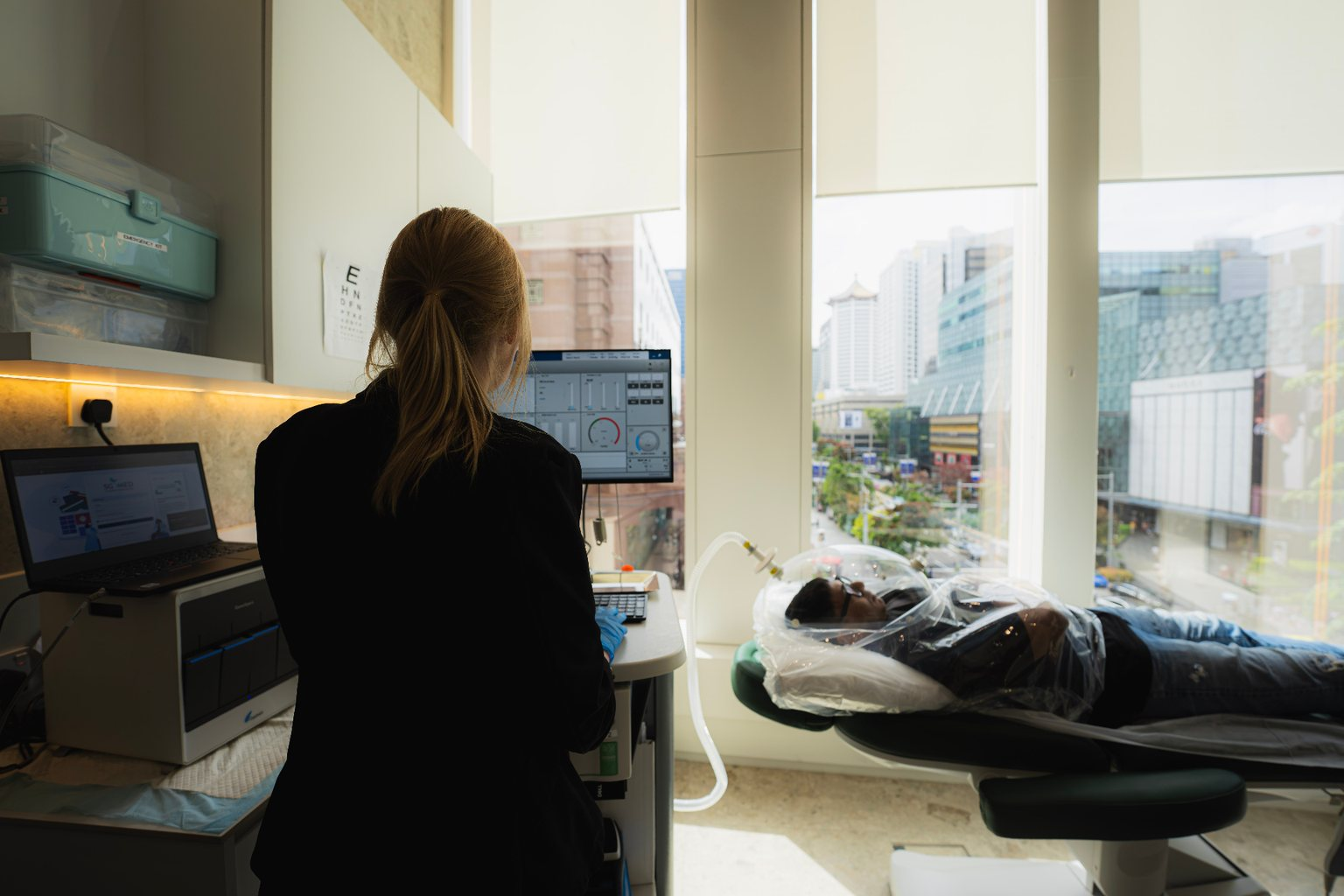
Pengukuran 15 menit mengenai berapa banyak kalori yang dibakar tubuh Anda saat istirahat, dilakukan dengan kalorimetri tidak langsung di Hisential Orchard. Tidak ada olahraga yang terlibat. Konsumsi oksigen Anda diukur, bukan diperkirakan dengan rumus, dan dokter mengubahnya menjadi target energi harian yang dibaca bersamaan dengan komposisi tubuh dan darah Anda.
Diverifikasi oleh Dr. Anthony Stanislaus, MBBS, PBM, Cert. Men's Health · Terakhir diulas 12 Agustus 2026 · Tinjauan berikutnya 12 Februari 2027
Apa yang diukur dengan pengujian RMR
Laju metabolisme istirahat adalah jumlah kalori yang dibakar tubuh untuk menjaga Anda tetap hidup: pernapasan, sirkulasi, aktivitas otak, fungsi ginjal, dan perbaikan sel. Bagi kebanyakan orang, kalori menyumbang sekitar 60 hingga 70 persen dari total penggunaan energi harian, yang menjadikannya komponen terbesar dari kebutuhan kalori Anda dan layak untuk diukur secara akurat.
Ini diukur dengan kalorimetri tidak langsung. Konsumsi oksigen dan produksi karbon dioksida Anda dicatat saat Anda beristirahat, dan pengeluaran energi dihitung dari volume gas tersebut. Kondisi yang terstandar, waktu istirahat yang cukup dan keadaan puasa membuat pembacaan dapat direproduksi.[4]
Pengukuran tersebut juga melaporkan rasio pertukaran pernapasan Anda, yang menunjukkan keseimbangan lemak dan karbohidrat yang digunakan tubuh Anda sebagai bahan bakar saat istirahat.
Bagaimana hal itu dilakukan
- Anda beristirahat dengan tenang selama sekitar 15 menit, berbaring, di ruangan yang tenang.
- Anda kemudian bernapas secara normal ke alat analisa metabolik. Tidak ada yang berat dan tidak ada olahraga yang terlibat.
- Pengukurannya sendiri memakan waktu sekitar 15 menit.
- Pengujian dilakukan dengan cepat, pertama-tama di pagi hari jika memungkinkan, untuk mendapatkan pembacaan yang stabil.
- Seorang dokter meninjau hasilnya dan melaporkannya sebagai dasar metabolisme Anda dengan target energi harian.
Mengapa metabolisme penting bagi kesehatan
Rentang kesehatan adalah jumlah tahun yang Anda habiskan dalam kondisi kesehatan fungsional yang baik. Dua pengaruh paling kuat terhadap hal tersebut adalah komposisi tubuh dan kesehatan metabolisme, dan tingkat metabolisme istirahat berada di titik pertemuan keduanya: hal ini sangat ditentukan oleh seberapa banyak jaringan otot yang aktif secara metabolik yang Anda bawa.[6]
Otot tidak hanya untuk kekuatan. Ini adalah tempat utama pembuangan glukosa dan cadangan yang digunakan tubuh selama sakit dan pemulihan, dan hilangnya glukosa seiring bertambahnya usia menyebabkan kelemahan dan pemulihan yang lebih lambat. Tingkat metabolisme istirahat yang menurun selama bertahun-tahun, ketika berat badan tidak berubah, sering kali merupakan tanda kuantitatif paling awal bahwa jaringan tanpa lemak sedang hilang.[6]
Tingkat metabolisme juga sensitif terhadap perubahan hormonal. Hormon tiroid adalah pengatur utama pengeluaran energi istirahat, sehingga pengukuran yang rendah atau tinggi secara tidak terduga dapat menjadi petunjuk bagi dokter untuk memeriksa fungsi tiroid dan darah lainnya.[7]
Penelitian mengenai penuaan telah meneliti tingkat metabolisme istirahat secara dua arah, dengan beberapa penelitian kohort melaporkan bahwa tingkat yang lebih tinggi pada orang dewasa yang lebih tua berhubungan dengan risiko kematian, sementara tingkat yang sangat rendah menyertai hilangnya jaringan tanpa lemak. Pembacaan jujurnya adalah bahwa RMR adalah penanda fisiologis yang harus diinterpretasikan dalam konteks, bukan skor untuk dimaksimalkan atau diminimalkan.[5]
Temuan ini menggambarkan pola yang diamati di seluruh populasi. Itu bukanlah prediksi tentang individu mana pun. Apa yang diberikan pengukuran tersebut adalah titik awal yang akurat dan cara untuk melihat apakah tindakan Anda selanjutnya dapat menggerakkannya.
Diukur terhadap prediksi
Kebanyakan target kalori berasal dari persamaan prediktif seperti Harris-Benedict atau Mifflin-St Jeor, menggunakan tinggi badan, berat badan, usia dan jenis kelamin. Persamaan tersebut dibuat agar akurat secara rata-rata di seluruh populasi. Tinjauan sistematik yang membandingkan angka-angka tersebut dengan nilai terukur menunjukkan bahwa persamaan dengan kinerja terbaik sekalipun berada dalam rentang 10 persen dari angka yang diukur hanya pada sekitar 70 persen orang dewasa yang tidak mengalami obesitas, dan lebih sedikit pada mereka yang mengalami obesitas, dengan kesalahan individu yang menghasilkan beberapa ratus kalori sehari pada kedua arah tersebut.[1], [2]
Bagi seseorang yang merencanakan defisit atau surplus, beberapa ratus kalori adalah solusinya. Hal ini berlaku untuk mengukur, bukan memprediksi.
Pengeluaran energi istirahat juga tidak tetap. Tindak lanjut peserta setelah penurunan berat badan yang signifikan mendokumentasikan tingkat metabolisme istirahat yang tetap beberapa ratus kalori sehari di bawah tingkat yang diperkirakan untuk ukuran tubuh baru mereka, dan bertahan bertahun-tahun kemudian.[3] Mengukur tarif Anda saat ini, daripada mengasumsikan tarif yang Anda miliki sebelumnya, adalah hal yang membuat rencana tetap realistis.
We often use the result as the starting point for a structured weight loss programme.
Diprediksi
Formula berdasarkan tinggi badan, berat badan, usia dan jenis kelamin. Gratis, instan, dan akurat untuk rata-rata populasi, bukan untuk Anda. Komposisi tubuh, status tiroid, riwayat diet dan pelatihan bukan merupakan input.
Diukur
Konsumsi oksigen dan produksi karbon dioksida Anda sendiri, diambil saat istirahat dalam kondisi standar. Dapat diulang, dapat dibandingkan dari waktu ke waktu, dan spesifik untuk fisiologi Anda saat ini.
Membaca laporan RMR Anda
Kalori istirahat yang diukur per hari
Gambar utama Anda: energi yang digunakan tubuh Anda saat istirahat total selama 24 jam, diukur, bukan diprediksi.
Diukur terhadap prediksi
Angka yang sama di samping asumsi persamaan standar untuk Anda, sehingga ukuran dan arah kesenjangan terlihat.
Rasio pertukaran pernapasan
Keseimbangan lemak dan karbohidrat yang digunakan tubuh Anda sebagai bahan bakar saat istirahat, memberikan konteks pada angka kalori.
Target energi harian
Tingkat istirahat Anda disesuaikan dengan aktivitas aktual Anda, lalu disesuaikan dengan tujuan Anda, apakah itu kehilangan, pemeliharaan, atau perolehan.
Baca dengan komposisi tubuh
Massa tanpa lemak adalah pendorong utama laju metabolisme istirahat, sehingga keduanya diinterpretasikan secara bersamaan, bukan secara terpisah.
Interpretasi dokter
Ringkasan bahasa sederhana yang mencatat segala hal yang memerlukan peninjauan lebih lanjut, seperti fungsi tiroid yang angkanya jauh di luar ekspektasi.
Apa yang menggerakkan tingkat metabolisme istirahat Anda
Tingkat metabolisme istirahat tidaklah tetap, namun juga tidak berubah sesuai permintaan. Faktor-faktor di bawah ini adalah faktor-faktor yang memiliki pengaruh nyata, dan pengukuran berulang adalah cara Anda melihat faktor mana yang diterapkan pada Anda.
Massa ramping
Jaringan otot dan organ menyumbang sebagian besar penggunaan energi istirahat Anda. Pelatihan ketahanan dan protein yang cukup adalah pendorong dengan bukti terkuat di baliknya.
Pembatasan kalori yang berkepanjangan
Defisit yang meluas berhubungan dengan tingkat istirahat yang berada di bawah tingkat yang diperkirakan untuk ukuran tubuh baru, dan kesenjangan tersebut dapat terus berlanjut.
Fungsi tiroid
Hormon tiroid adalah pengatur utama pengeluaran energi istirahat, sehingga aktivitas yang kurang atau berlebihan akan terlihat dalam pengukuran.
Usia
Tingkat istirahat menurun secara bertahap seiring bertambahnya usia, sebagian besar disebabkan oleh hilangnya jaringan ramping dan bukan karena perlambatan sel secara intrinsik.
Penyakit dan pemulihan
Demam, infeksi, dan pemulihan setelah operasi meningkatkan kebutuhan energi untuk sementara waktu, hal ini penting ketika nutrisi sedang direncanakan.
Stimulan dan obat-obatan
Kafein, nikotin, pengganti tiroid, dan beberapa obat lain mengubah pembacaannya, itulah sebabnya petunjuk persiapannya sangat ketat.
Untuk siapa pengujian RMR
- Siapa pun yang mengelola berat badan yang menginginkan target kalori diukur, bukan diperkirakan oleh aplikasi.
- Orang-orang yang berat badannya terhenti pada sebuah rencana yang seharusnya, di atas kertas, berhasil.
- Pasien yang pernah mengalami penurunan berat badan secara signifikan sebelumnya dan ingin mengetahui di mana posisi metabolismenya saat ini.
- Orang yang membangun otot membutuhkan surplus yang akurat, bukan hanya perkiraan.
- Pasien diperiksa karena kelelahan, intoleransi dingin, atau perubahan berat badan yang tidak dapat dijelaskan, disertai darah.
- Siapa pun yang menggunakan paket pemeriksaan umur panjang yang mencakup pengukuran metabolisme.
Protokol dan persiapan hari ujian
Sebelum ujianmu
- Puasa setidaknya selama delapan jam. Air biasa baik-baik saja dan dianjurkan.
- Tidak ada kafein, nikotin atau suplemen pada pagi hari ujian.
- Tidak ada olahraga sebelumnya. Pergilah ke klinik tanpa terburu-buru jika memungkinkan.
- Beritahu kami tentang pengobatan apa pun, terutama pengganti tiroid dan stimulan.
- Janji temu di pagi hari lebih disukai karena pembacaannya paling stabil.
Pada hari itu
- Sekitar 15 menit istirahat dengan tenang, berbaring, sebelum apa pun direkam.
- Sekitar 15 menit pengukuran sambil bernapas normal ke dalam alat analisa.
- Komposisi tubuh biasanya diukur dalam satu kunjungan, karena keduanya dibaca bersamaan.
- Dimana VO2 max dibooking juga, RMR dilakukan terlebih dahulu saat berpuasa.
- Biarkan total sekitar 30 menit.
Apa yang tes ini tidak beritahukan kepada Anda
- Ini bukan tes diagnostik. Hasil yang tidak terduga mungkin memerlukan pemeriksaan darah lebih lanjut, namun pengukuran itu sendiri tidak menghasilkan diagnosis apa pun.
- Ini hanya mengukur penggunaan energi istirahat. Total pengeluaran harian Anda juga bergantung pada aktivitas dan biaya energi untuk mencerna makanan.
- Ini adalah snapshot yang diambil dalam kondisi standar. Kurang tidur, penyakit, makanan baru-baru ini, atau kafein akan mengubah angka tersebut.
- Itu tidak memberi tahu Anda apa yang harus dimakan. Menerjemahkan angka tersebut ke dalam rencana terjadi setelah berkonsultasi dengan dokter Anda.
- Perbandingan hanya berlaku bila pengujian diulangi dalam kondisi puasa dan istirahat yang sama pada penganalisis yang sama.
- Ini bukan ukuran kebugaran. Kapasitas kardiorespirasi dinilai secara terpisah melalui pengujian VO2 max.
Cara memesan
Pengujian RMR dapat dipesan sendiri, atau sebagai bagian dari Tingkat umur panjang Helios dan Orion dan itu Paket Performa Maksimal dan Manajemen Berat Badan. Harga disediakan oleh pramutamu pribadi Anda sebelum Anda memesan, dengan biaya penuh dikonfirmasi di muka.
Pertanyaan pengujian tingkat metabolisme istirahat
Jawaban yang jelas, ditulis oleh tim klinis kami. Ketuk pertanyaan apa pun untuk mendapatkan tautan permanen langsungnya, atau hubungi Pramutamu Pribadi Anda untuk pertanyaan lain.
Ini mengukur berapa banyak kalori yang dibakar tubuh Anda saat istirahat dengan kalorimetri tidak langsung: konsumsi oksigen dan produksi karbon dioksida diukur saat Anda berbaring diam, dan pengeluaran energi Anda dihitung dari volume gas tersebut. Pengukuran memakan waktu sekitar 15 menit dan tidak melibatkan olahraga.
Sebuah aplikasi menerapkan persamaan prediksi berdasarkan tinggi badan, berat badan, usia dan jenis kelamin. Persamaan tersebut dibuat agar akurat secara rata-rata di seluruh populasi, dan perbandingan yang dipublikasikan terhadap nilai terukur menunjukkan kesalahan individu sebesar beberapa ratus kalori sehari. Tes RMR mengukur angka Anda sendiri, bukan memperkirakannya.
Tingkat metabolisme istirahat yang diukur di bawah nilai yang diprediksi oleh formula dapat mencerminkan massa otot yang lebih rendah, periode pembatasan kalori yang berkelanjutan, faktor tiroid atau hormonal lainnya, atau sekadar variasi individu. Hal ini ditafsirkan bersamaan dengan komposisi tubuh, hasil darah, dan riwayat penyakit Anda, bukan dibaca sendiri-sendiri.
Angka yang lebih tinggi dari perkiraan sering kali mencerminkan massa ramping yang lebih besar daripada asumsi rumus. Lebih jarang, penyakit ini dapat menyertai aktivitas tiroid yang berlebihan, demam, atau penggunaan stimulan baru-baru ini. Dokter Anda membacanya dengan darah dan riwayat Anda sebelum menarik kesimpulan apa pun.
Puasa setidaknya delapan jam, dengan air putih dianjurkan. Tidak mengonsumsi kafein, nikotin, atau suplemen pada pagi hari tes, tidak berolahraga sebelumnya, dan pergi ke klinik tanpa terburu-buru jika memungkinkan. Anda kemudian beristirahat dengan tenang selama sekitar 15 menit sebelum pengukuran dimulai.
Laju metabolisme istirahat sangat erat hubungannya dengan massa otot, jadi latihan ketahanan dan protein yang cukup adalah faktor yang memberikan bukti terkuat di balik hal tersebut. Diet ketat cenderung melakukan hal sebaliknya. Kami melaporkan berapa tarif Anda dan apa yang dilakukannya dari waktu ke waktu, bukan hanya menjanjikan angka.
Masih ada pertanyaan?
Pramutamu Pribadi Anda membalas dalam satu hari kerja - secara rahasia.
Referensi
- [1] Frankenfield D, Roth-Yousey L, Compher C. Perbandingan persamaan prediktif untuk tingkat metabolisme istirahat pada orang dewasa sehat nonobesitas dan obesitas: tinjauan sistematis. Jurnal Asosiasi Diet Amerika. 2005;105(5):775-789.
- [2] Mifflin MD, St Jeor ST, Hill LA, et al. A new predictive equation for resting energy expenditure in healthy individuals. American Journal of Clinical Nutrition. 1990;51(2):241-247.
- [3] Fothergill E, Guo J, Howard L, et al. Persistent metabolic adaptation 6 years after The Biggest Loser competition. Obesity. 2016;24(8):1612-1619.
- [4] Compher C, Frankenfield D, Keim N, Roth-Yousey L. Metode praktik terbaik untuk diterapkan pada pengukuran laju metabolisme istirahat pada orang dewasa: tinjauan sistematis. Jurnal Asosiasi Diet Amerika. 2006;106(6):881-903.
- [5] Ruggiero C, Ferrucci L. Upaya homeostasis pemeliharaan tinggi: tingkat metabolisme istirahat dan warisan umur panjang. Jurnal Gerontologi Seri A. 2006;61(5):466-471.
- [6] Wolfe RR. Peran otot yang kurang dihargai dalam kesehatan dan penyakit. Jurnal Nutrisi Klinis Amerika. 2006;84(3):475-482.
- [7] Mullur R, Liu YY, Brent GA. Pengaturan metabolisme hormon tiroid. Ulasan Fisiologis. 2014;94(2):355-382.
Halaman terkait
Tes VO2 Max
Kebugaran kardiorespirasi diukur dengan zona pelatihan yang ditetapkan dari ambang batas Anda sendiri.
Paket Manajemen Berat Badan
Nutrisi, resep olahraga dan pengukuran metabolisme dalam satu program yang ditinjau.
Paket Pemeriksaan Umur Panjang
Empat tingkatan yang menggabungkan epigenetika, mikrobioma usus, dan pengujian fungsi fisik.
Ditinjau secara medis oleh Dr. Anthony Stanislaus, MBBS, PBM, Cert. Men's Health
Terakhir ditinjau 12 Agustus 2026 · Tinjauan berikutnya 12 Februari 2027