
Health Screening · Orchard, Singapore
Ultrasound Imaging at Hisential Orchard Clinic, Singapore
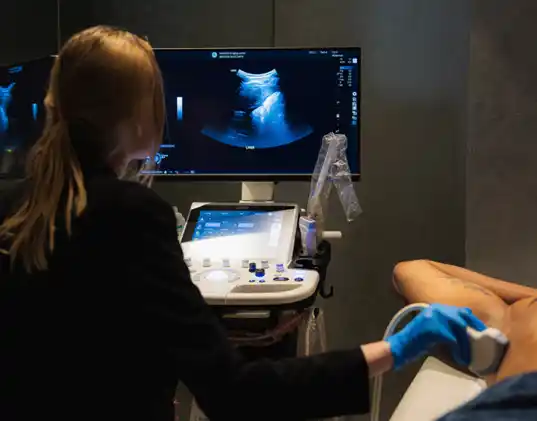
Ultrasound is performed on-site at Mandarin Gallery, sometimes during the same visit as your consultation. Where a scan needs fasting, or there is no slot free, your concierge arranges it for another day or at a neighbouring radiology centre. No external referral is required from you, and every scan is reported by a Singapore-licensed radiologist.
Medically reviewed by Dr. Julian Ng, MBBS (University of Sydney), MSc Microbiology (NUS), Cert. Men's Health (SMHS)
Last reviewed 13 August 2026 · Next review 13 February 2027
How ultrasound fits into your screening
Ultrasound looks at structure, where blood tests look at function. A scan is chosen because a symptom, an examination finding or a blood result makes a particular organ worth looking at, not because more imaging is better.
Some scans need preparation: a full bladder for the urinary, prostate and pelvic scans, and a six-hour fast for the hepatobiliary scan. Those are arranged in advance rather than added unprepared.
Michelangelo
Includes 1 scan, chosen with your doctor from the ultrasound options below.
Van Gogh
Includes 2 scans, chosen with your doctor from the ultrasound options below.
Da Vinci
Includes 3 scans, chosen with your doctor from the ultrasound options below.
Scans beyond the number included in your package are priced by your concierge before anything is booked. You can see how the scan allocation sits within each tier on comprehensive health screening.
Scans can also be booked individually. Individual scans are available to Hisential patients, and a first consultation establishes that: a doctor sees you, agrees the scan with you and reviews the report with you afterwards. This is not a walk-in imaging service.
Thyroid ultrasound
A thyroid ultrasound examines the thyroid gland in the front of the neck and the lymph nodes beside it, looking at gland size, texture and whether any nodules are present.
It is typically requested when a lump is felt in the neck, when thyroid blood tests are abnormal, or when a nodule has been found incidentally and needs characterising and following.
You lie back with the neck slightly extended, gel is applied, and a small probe is passed over the front of the neck. Nothing is injected and no preparation is needed.
Kidney, ureter and bladder ultrasound
This scan examines both kidneys, the drainage tracts and the bladder, including bladder wall appearance and how much urine remains after passing water.
It is typically requested for blood in the urine, recurrent urinary infections, suspected stones, abnormal kidney blood tests, or urinary symptoms such as a poor stream or incomplete emptying.
You are asked to attend with a comfortably full bladder. The scan is performed through the flanks and lower abdomen, and is often repeated after you empty the bladder to measure what is left behind.
Scrotal ultrasound
A scrotal ultrasound examines both testes, the epididymis and the surrounding structures, including blood flow within them.
It is typically requested for a lump felt in the scrotum, testicular pain or swelling, suspected varicocele or cyst, and as part of an assessment for fertility concerns.
The scan is performed with the scrotum supported and gel applied. It takes a few minutes, a chaperone is available, and no preparation is needed.
Prostate ultrasound
A prostate ultrasound measures the size and shape of the prostate gland and looks at the bladder above it, including how completely the bladder empties.
It is typically requested where urinary symptoms suggest an enlarged prostate, alongside a raised PSA result, or to follow a gland already known to be enlarged. It is a structural scan and does not itself diagnose cancer.
Most scans are performed through the lower abdomen with a full bladder. Whether a transrectal approach adds anything in your case is a decision your doctor discusses with you first.
Read more about benign prostatic hyperplasia and prostate cancer screening.
Hepatobiliary ultrasound (liver, gallbladder, bile ducts, pancreas)
This scan examines the liver, the gallbladder, the bile ducts and the parts of the pancreas that ultrasound can reach, looking at texture, size and whether stones or duct dilatation are present.
It is typically requested for abnormal liver blood tests, upper abdominal pain, suspected gallstones, or where fatty liver has been raised as a possibility on other results.
You are asked to fast beforehand, usually for six hours, so the gallbladder is distended. The scan is performed over the upper abdomen and you may be asked to breathe in and hold.
Breast ultrasound
A breast ultrasound examines breast tissue and the lymph nodes in the armpit, and is used to characterise a lump or an area of concern rather than to replace mammography.
It is typically requested for a palpable lump, focal pain, nipple discharge, or to look further at an area flagged on another test. It is often the first imaging choice in younger women, whose breast tissue is denser.
You lie with the arm raised, gel is applied and the area is scanned systematically. A chaperone is available and no preparation is needed.
Pelvic ultrasound
A pelvic ultrasound examines the uterus, the ovaries and the surrounding pelvic structures, including the thickness of the womb lining.
It is typically requested for pelvic pain, heavy or irregular bleeding, suspected fibroids or ovarian cysts, and as part of an assessment for fertility concerns.
The scan is usually performed through the lower abdomen with a full bladder. A transvaginal approach gives a closer view and is only used with your consent, discussed with you beforehand.
Ultrasound imaging - questions
Clear answers, written by our clinical team. Tap any question for its direct permalink, or reach out to your Personal Concierge for anything else.
No referral from another clinic is needed. Your Hisential doctor decides with you which scan is appropriate at your consultation, and your concierge arranges it from there. Some scans are done on-site at Mandarin Gallery during the same visit; where fasting is needed or no slot is free, the scan is arranged for another day or at a neighbouring radiology centre, with no referral for you to organise.
Yes, a scan can be added, though the date is subject to availability. Your doctor confirms the scan is appropriate for you, and your concierge arranges the date and confirms the price for any scan beyond the number included in your package before it goes ahead. Scans that need preparation are arranged for another day, usually within about two days, or at a neighbouring radiology centre.
Scrotal and prostate ultrasound apply to men. Breast and pelvic ultrasound are the scans usually chosen by women. Thyroid, kidney, ureter and bladder, and hepatobiliary ultrasound apply to both. Which of these is worth doing for you is a conversation with your doctor, not a list you pick from unaided.
Yes. Individual scans are available to Hisential patients, and a first consultation establishes that relationship. This is not a walk-in imaging service: a doctor sees you, agrees the scan with you and reviews the radiologist's report with you afterwards.
Fees are private and payable in full at the visit. MediSave, CHAS and Healthier SG subsidies do not apply. Some insurance plans cover consultations and investigations on a reimbursement basis: you pay the clinic and claim back from your insurer afterwards. The concierge provides the documentation you need and helps with the claim paperwork. Instalment payment is available: ask the concierge about the options before your visit.
Still have a question?
Your Personal Concierge replies within one business day - confidentially.
Arrange your scan
Your doctor agrees the scan with you, your concierge arranges it at Mandarin Gallery or at a neighbouring radiology centre, and the radiologist's report is reviewed with you within 48 hours.