
ED treatment option

Li-ESWT Shockwave Therapy for Erectile Dysfunction

Non-invasive low-intensity focused shockwave therapy that addresses the underlying vascular cause of ED. Delivered at Hisential Clinics on the Medispec ED1000 - the linear focused Li-ESWT platform used in the landmark clinical trials of this treatment.

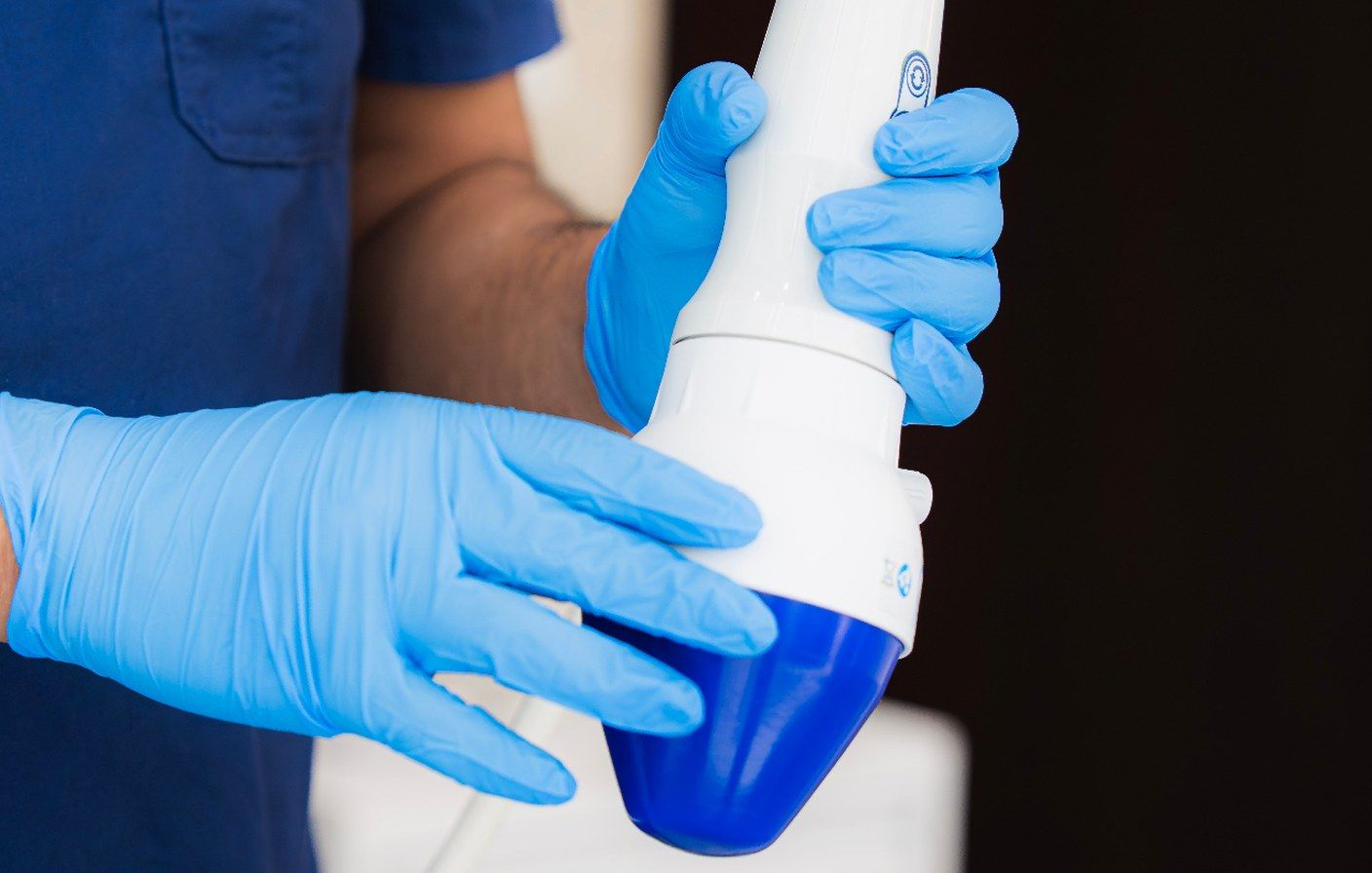
Clinician in blue scrubs and nitrile gloves holding a low-intensity shockwave therapy handpiece at Hisential.

Quick answer

Low-intensity extracorporeal shockwave therapy (Li-ESWT) uses focused acoustic waves to stimulate new blood vessel growth (angiogenesis) in penile tissue, restoring the vascular function that supports an erection. A typical course is 6-12 sessions over 6 weeks, with no anaesthesia and no downtime. Meta-analyses report meaningful improvement in erectile function scores in roughly 60-70% of appropriately selected men, with effects lasting 12-24 months and often longer.

Medically reviewed by Dr. Julian Ng, MBBS (University of Sydney), MSc Microbiology (NUS), Cert. Men's Health (SMHS)

Last reviewed 1 May 2026 · Next review 1 November 2026

How Li-ESWT works

Focused low-intensity acoustic shockwaves are delivered to the penile shaft and crura through a handheld applicator. The mechanical stimulus triggers a cascade of cellular responses - recruitment of endothelial progenitor cells, upregulation of VEGF and other growth factors, and proliferation of new microvasculature in the cavernosal tissue.

The clinical goal is to restore erectile function rather than to provide an on-demand effect. Unlike PDE5 inhibitors, Li-ESWT works on the underlying vascular substrate and aims for sustained improvement that persists between - and beyond - sessions.

Each session takes 15-20 minutes, requires no anaesthesia, and has no downtime. Most men resume normal activity, including exercise, immediately.

Who Li-ESWT suits

The strongest evidence supports Li-ESWT in men with vascular-pattern ED, particularly under 65, who have had partial or no response to PDE5 inhibitors. It can shift a meaningful proportion of PDE5 non-responders back into responder status.

It is less effective in men with severe diabetes-related microvascular damage, post-radical-prostatectomy nerve injury, or end-stage atherosclerosis. The Hisential workup includes a vascular and metabolic assessment so eligibility is matched to mechanism, not just preference.

Effectiveness and treatment course

A typical Hisential course is 6-12 sessions delivered over 6 weeks. Improvement usually begins around sessions 3-4 and continues for several months after the course ends. The largest meta-analyses (see references below) report clinically meaningful improvement in IIEF-EF scores in 60-70% of appropriately selected men, with durable effect at 12-24 months and sometimes longer.

Li-ESWT pairs well with optimised PDE5 dosing and a metabolic protocol. Many men can subsequently reduce their PDE5 dose or move to as-needed use.

Safety profile

Li-ESWT has an excellent safety profile across published studies. The most common reports are mild transient tenderness, occasional minor bruising, and brief skin redness. No serious adverse events have been reliably attributed to focused Li-ESWT for ED in randomised trials.

It is not appropriate during active penile infection, with active malignancy in the treatment field, or in men with bleeding disorders. Your treating doctor reviews suitability before any course is scheduled.

Pricing

All figures below are inclusive of GST.

Prices last updated . Prices include GST unless stated otherwise and are confirmed by your concierge before anything is booked.

  • Introductory session: from S$150. This is the price of the introductory Li-ESWT session.
  • Within a package: S$350 per session. After the introductory session, Li-ESWT is sold in packages. S$350 is the per-session rate inside a package. There is no single-session rate, so this figure is not a walk-in price for one session.
  • Consultation: from S$50 after GST.
  • Teleconsultation for follow-ups: from S$50 after GST.

Your package is sized to the course your doctor recommends after assessment, so the total depends on the number of sessions agreed. Where Li-ESWT is combined with oral medication or hormonal treatment, those are quoted separately and clearly.

Patient pathway and follow-up

A complete clinical episode at Hisential is structured around four clearly-defined stages, so patients understand what to expect at each visit and how decisions are made.

Stage 1 - Pre-consultation triage. Before your first appointment about Li-ESWT, our care coordinators take a brief history by WhatsApp or phone to determine whether teleconsultation, an in-clinic visit, or a same-day workup is most appropriate. This avoids unnecessary travel for issues that can be triaged remotely, and ensures patients with urgent presentations are prioritised. Where laboratory tests, imaging, or fasting are likely to be needed, we explain the requirements in advance so the first visit is productive rather than purely exploratory.

Stage 2 - In-clinic assessment. The first consultation includes a structured medical history, focused examination, and, where clinically indicated, point-of-care or laboratory investigations. Doctors document findings in our digital records system and walk patients through the rationale for each test. Costs are confirmed before any chargeable investigation is performed; nothing is added without consent.

Stage 3 - Diagnosis, plan, and shared decision-making. Once results are available, the doctor reviews them with the patient in plain language, including normal ranges, areas of concern, and the level of evidence behind any proposed intervention. For Li-ESWT, treatment options are framed in terms of expected benefit, realistic timelines, side-effect profile, and cost. Patients are encouraged to ask questions and may request a second appointment to consider their options before starting treatment; there is no pressure to decide on the day.

Stage 4 - Follow-up and continuity. Follow-up intervals are agreed at the end of the first visit and depend on the condition: chronic management is typically reviewed every 3-6 months, while acute episodes may be reviewed within 1-4 weeks. Teleconsultation (from S$50 after GST) is offered for routine follow-ups where physical examination is not required. Records are retained securely and remain accessible to the patient on request, including for onward referral or coordination with another doctor.

What we will not do

Hisential does not sell unproven therapies, does not recommend tests without a clinical indication, and does not extend treatment courses beyond what the evidence supports. If a condition falls outside our scope - for example, requiring inpatient care, surgical sub-specialty input, or oncology services - we say so and refer appropriately. Honest scope is part of the standard.

Are all shockwave machines the same?

Why the device matters - and why we use the Medispec ED1000

"Shockwave therapy" is used loosely in clinics worldwide, but it covers two very different technologies, and they are not interchangeable for erectile dysfunction.

  • Radial pressure waves (RSWT). Generated by a pneumatic projectile striking an applicator head. These are pressure waves, not true shockwaves: the energy peak is at the skin surface and diffuses rapidly. RSWT devices are cheaper and widely marketed for ED, but the published ED evidence base does not use them - it uses focused shockwaves. Outcomes from focused trials cannot be claimed for radial machines.
  • Focused shockwaves. True shockwaves generated and concentrated at a defined tissue depth, so the therapeutic energy is delivered where neovascularisation needs to occur rather than at the skin. This is the technology used in the randomised trials of Li-ESWT for ED.

The Medispec ED1000 is a linear focused Li-ESWT platform built specifically for sexual medicine, with a linear applicator that treats along the length of the penile shaft and the crura rather than at a single point. Its distinguishing feature is not a marketing claim - it is the device on which the foundational clinical evidence for shockwave therapy in ED was generated.

Why this matters clinically:

  • The outcomes we quote were produced on this exact platform. Vardi's original 2010 pilot in European Urology, the 2012 randomised sham-controlled trial, and Kitrey's 2016 Journal of Urology study shifting PDE5 non-responders into responders were all performed on the Medispec ED1000 (see references below).
  • Protocol fidelity is possible. Because the published treatment protocols - pulse counts, energy flux density, anatomical mapping across five treatment points - were written for this device, they can be reproduced here rather than approximated.
  • A long andrology track record. Medispec's ED1000 has been in clinical use for sexual medicine for over a decade and features throughout the systematic reviews and meta-analyses published in the Journal of Sexual Medicine and the International Journal of Impotence Research.

An honest caveat: the device is necessary but not sufficient. Protocol fidelity (number of pulses, energy flux density, anatomical mapping), operator training and patient selection matter as much as the platform itself. Hisential combines a research-grade device with a structured protocol and an SMC-registered medical team rather than relying on one factor in isolation.

Selected references

  1. Vardi Y, Appel B, Jacob G, Massarwi O, Gruenwald I. Can low-intensity extracorporeal shockwave therapy improve erectile function? A 6-month follow-up pilot study. Eur Urol. 2010;58(2):243-248.
  2. Kitrey ND, Gruenwald I, Appel B, Shechter A, Massarwa O, Vardi Y. Penile low intensity shock wave treatment is able to shift PDE5i nonresponders to responders: A double-blind, sham-controlled study. J Urol. 2016;195(5):1550-1555.
  3. Clavijo RI, Kohn TP, Kohn JR, Ramasamy R. Effects of low-intensity extracorporeal shockwave therapy on erectile dysfunction: a systematic review and meta-analysis. J Sex Med. 2017;14(1):27-35.
  4. Sokolakis I, Hatzichristodoulou G. Clinical studies on low intensity extracorporeal shockwave therapy for erectile dysfunction: a systematic review and meta-analysis of randomised controlled trials. Int J Impot Res. 2019;31(3):177-194.
  5. Capogrosso P, Frey A, Jensen CFS, et al. Low-intensity shock wave therapy in sexual medicine - clinical recommendations from the EAU Section of Sexual and Reproductive Health (ESSM-EAU). J Sex Med. 2019;16(10):1490-1505.

Frequently asked questions

FAQ

Frequently asked questions

Clear answers, written by our clinical team. Tap any question for its direct permalink, or reach out to your Personal Concierge for anything else.

  1. Is Li-ESWT the same as the shockwave therapy offered for sports injuries?

    The underlying physics is similar but the energy levels, applicator geometry and protocols differ significantly. Li-ESWT for ED uses lower energy, focused shockwaves and a sexual-medicine-specific protocol - at Hisential, the Medispec ED1000 protocol used in the published trials. Always confirm the device and protocol used.

  2. Does Li-ESWT hurt?

    Most patients describe the sensation as mild tapping or pressure rather than pain. The procedure is non-invasive, requires no anaesthesia, and there is no downtime afterwards.

  3. How many sessions will I need?

    A typical Hisential course is 6-12 sessions over 6 weeks. The exact number depends on severity and response. Improvement usually begins around sessions 3-4 and continues for several months after the course ends.

  4. How long do the effects last?

    Published evidence shows durable improvement at 12-24 months and often longer in appropriately selected men. Maintenance sessions are sometimes used after 12-18 months if symptoms drift back.

  5. Can I combine Li-ESWT with PDE5 inhibitors?

    Yes - and many men benefit from combined use during and immediately after the course, with a gradual reduction in PDE5 dose as vascular response improves.

Still have a question?

Your Personal Concierge replies within one business day - confidentially.

Continue exploring

Speak to your personal health concierge

One dedicated contact who coordinates your evaluation, treatment plan and follow-ups end-to-end. Confidential by default.